
- By Danish
- September 28, 2026
- Microwave
Choosing the Best Cooker for Your Kitchen: Gas vs Induction
There’s a particular kind of noise that means Sunday lunch is coming together, the hiss of onions hitting hot oil, the low bubble of a stew finding its rhythm, the clatter of a spoon against a pot that’s seen a decade of pepper soup. In most West African homes, that noise comes from one place: the cooker. It’s not just an appliance. It’s the anchor of the whole kitchen, and often the whole household, organises itself around.
But the kitchens holding those cookers are changing fast. Walk through any new development in Lagos, Accra, Abidjan, or Dakar and you’ll see it: open-plan living spaces, handleless cabinetry, waterfall-edge countertops that used to belong strictly to design magazines. The old walled-off cooking room is giving way to a kitchen that’s meant to be seen.
Which raises a real question for anyone furnishing that space. Gas has run West African kitchens for generations, and it isn’t going anywhere soon. But induction, quiet, glassy, almost futuristic, keeps catching eyes in appliance showrooms. So, which one actually belongs on your countertop? Let’s find out.
Gas Cookers: The Reigning Monarch of West African Kitchens
Ask any home cook from Kumasi to Kaduna why they trust gas cookers, and the answer is almost always the same: it never lets you down. Load-shedding schedule kicks in at 6pm right when the stew’s supposed to be simmering? Gas stoves don’t care. They burn exactly the same whether the grid is up, down, or somewhere in between which, depending on which part of the city you live in, might be most days of the week.
That independence comes bundled with real cooking flexibility. Gas doesn’t discriminate against cookware. Your grandmother’s cast-iron skillet, a curved-bottom wok, a clay pot for banku, the dented aluminium pressure pot that’s cooked a thousand pots of beans, all of it works, no adapters, no compatibility checks. And because the flame is right there, visible, you get instant feedback: turn the knob and the heat responds immediately, which matters when you’re searing meat, flame-roasting peppers for shito, or bringing a full stockpot of oxtail to a hard boil.
None of that comes free, though. An open flame dumps a surprising amount of heat straight into the room, stand over a gas cooker mid-stew on a humid afternoon and you’ll feel it, especially in a kitchen without heavy air conditioning. There’s also the maintenance reality nobody puts on the brochure: grease finds its way into every crevice of the burner caps and grates, and a proper deep-clean is a Saturday-morning chore, not a wipe-down. And gas, being gas, asks for respect, leaky hoses, poorly ventilated rooms, and careless cylinder handling are genuine safety issues, not scare tactics.
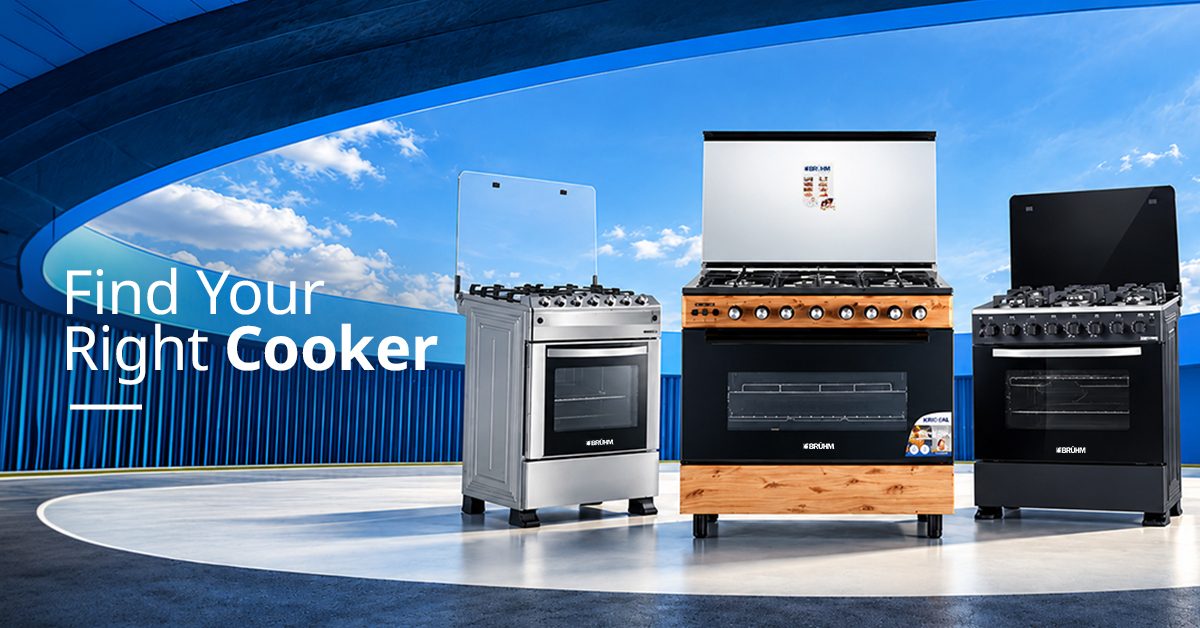
None of this makes gas old-fashioned. Modern gas cookers have quietly gotten a lot smarter about these drawbacks. Bruhm’s 90×60 gas cooker and 60×60 gas cooker ranges, for instance, pair the traditional flame-and-flexibility strengths with tempered glass worktops and mirror lids that wipe clean in seconds, auto-ignition so you’re not fumbling with matches, and gas ovens with an inside lamp for proper baking and roasting, proof that “reliable” and “easy to live with” aren’t mutually exclusive anymore. If space is tight, a compact small gas cooker from Bruhm’s 50×50 range delivers the same core reliability in a footprint that fits a smaller kitchen without any compromise on daily cooking power.
Induction Cooktops: The Modern Contender
Induction looks like it belongs in a futuristic space, but the science behind it is refreshingly simple: an electromagnetic coil beneath the glass surface generates a field that heats the pot itself directly, rather than heating the surface first and letting that heat transfer to the pot. Take the pot away, and the cooktop stays cool enough to touch within seconds. It’s a completely different relationship between heat and cookware than anything a gas stove offers.
The appeal of an induction cooker is obvious the moment you see one in a showroom. A flush, seamless black glass panel sits nearly invisible against quartz or granite, no grates, no burner caps, nothing breaking the line of a modern island. It’s genuinely fast, too: induction can boil a pot of water in close to half the time gas takes, because over 85% of the energy goes directly into the food rather than warming up the air and the pot’s exterior along the way, versus roughly 40% efficiency from an open gas flame. That efficiency shows up as a cooler kitchen during long cooking sessions, and a wipeable glass surface.
However, there is also the flipside: induction is picky about cookware. It only works with magnetic, ferrous metal, cast iron and magnetic stainless steel, essentially. That clay pot for palm nut soup, the pure aluminium stockpot, the copper saucepan you inherited, none of them will heat on an induction surface without an expensive adapter plate, and even then, results are inconsistent. Switching to an induction cooker can mean quietly replacing half your existing pot collection.
Another factor to consider is the power requirement. Induction needs stable, uninterrupted electricity, not “usually fine,” but genuinely reliable, because a single active zone can pull 1,800 to 2,200W. That’s not a problem if you’re on a strong feeder or running a 5kVA-plus solar-lithium setup that can shoulder that load. It’s a serious constraint if your neighbourhood sees six to twelve hours of grid access a day and your backup is a small petrol generator that struggles to carry that kind of draw alongside everything else in the house.
Head-to-Head Comparison Table
Sometimes the fastest way to see a gas cooker vs induction decision clearly is to lay it flat.
| Factor | Gas Cooker | Induction Cooker |
| Initial Cost | Low to Moderate | Moderate to High |
| Grid Reliability Need | None (100% independent) | High (needs strong grid or backup) |
| Cookware Flexibility | Any metal, clay, or stone | Ferrous/magnetic only |
| Ambient Kitchen Heat | High | Low |
| Cleaning Effort | High (burners, grates) | Extremely low (wipeable glass) |
| Safety | Flame & gas leak risks | Auto-shutoff, cool-to-touch |
West African Kitchen Realities: Making the Pragmatic Call
Here’s where the theory has to meet the actual rhythm of a real kitchen, and where the answer stops being about which kitchen appliances are “better” and starts being about what kind of household you have.
Start with what you cook. Long, slow simmers, goat meat pepper soup, palm nut soup, a stew that needs to sit and develop for an hour, work fine on either surface, though induction’s precision timers are genuinely good at preventing that bottom-of-the-pot scorch that happens when a flame runs slightly too hot for too long unattended. But scale matters here too: the oversized, heavy-bottomed pots many households use for big batches of soup or party-sized jollof often exceed the weight limits or burner footprint of a standard induction zone. It rules induction out entirely for some cooking styles, no matter how good the tech is on paper.
Then there’s the infrastructure question, and it deserves more nuance than “does the power go out sometimes.” What matters is your specific grid tier and your specific backup capacity. A household on a strong feeder with 18-plus hours of daily power, or one running a 5kVA-or-larger solar-lithium setup, can genuinely make induction its everyday workhorse and barely notice the difference. A household on a weaker feeder, six to twelve hours a day, backed by a small generator, is going to find induction frustrating, because that generator likely can’t carry a 2,000W cooking load alongside the fridge, the fans, and the lights. And if you’re renting a high-density apartment with no exterior venting, the calculation flips again: induction’s clean-air advantage becomes the priority, since running gas in an unventilated unit is a genuine indoor air quality risk, and a compact 3kg to 6kg cylinder is plenty as backup rather than a full-size tank you’re hauling up four flights of stairs.
Money matters too, and not just the sticker price. Weigh the recurring cost of LPG cylinder refills against your electricity tariff per kilowatt-hour. In most of the markets Bruhm serves, induction’s per-meal running cost comes out lower once you’re actually pulling power from a working grid or solar system. But that saving only materializes if the power is reliably there to use.
Which is exactly why the smartest kitchens across the region aren’t choosing sides at all. The pattern that keeps showing up, from working-class households in weak-grid neighbourhoods to high-income homes running strong solar, is fuel stacking: pairing an induction cooker for everyday boiling, frying, and sauce-making with a dependable gas setup as the mechanical backbone for heavy stirring, oversized pots, and outage-proof reliability. It’s why dual-fuel kitchens, with two gas burners sitting alongside two induction zones, have become the go-to recommendation from interior designers furnishing modern West African homes. You get the sleek, cool, efficient everyday experience induction offers, without losing the one thing gas has never failed to deliver: cooking that keeps going no matter what the grid is doing.
If you want to go deeper on how the two technologies actually compare side by side, cost, safety, and day-to-day energy use, this Bruhm guide walks through gas versus electric cooking in more detail, and it’s a useful companion read if you’re still weighing your primary cooktop.
The Verdict & Buying Checklist
There’s no universal right answer here, only the right answer for your kitchen, your grid, and your cooking style. Think of this as a mini cooker buying guide for your own home. A few honest signals to work from:
Opt for gas if you regularly cook in oversized aluminium or clay pots, live somewhere the grid is unpredictable, are renting and don’t have control over electrical upgrades, or simply want to know your Sunday stew is never at the mercy of a power cut.
Lean toward induction if you’ve got a dedicated solar or backup setup that can reliably carry the load, you’re chasing a clean, minimalist countertop look, or your daily cooking is mostly quick, boiling, frying, sauces, rather than heavy, hours-long pots.
Lean toward a hybrid setup if you’re like most modern West African households: cooking a genuine mix of quick meals and slow traditional dishes, on a grid that’s good but not flawless. This is, realistically, where the best cooker for home use ends up for most people, and it’s worth discussing with your interior designer or fitter before any countertop stone gets cut, since gas lines, ventilation, and electrical capacity all need planning for upfront, not retrofitted afterward.
Whichever direction you’re leaning, it helps to know what actually separates a good gas cooker from a mediocre one before you buy, this rundown of the top features worth checking on a gas cooker is a solid checklist to run through in the showroom. And if you’re curious what a well-built, African-kitchen-specific gas range actually looks like in practice, this closer look at the Bruhm gas cookers range is worth a read.
So, is your kitchen leaning gas, induction, or a bit of both? If you’re mid-renovation, loop your interior designer in before that countertop stone gets cut. The appliance decision is a lot easier to make when it’s made early.
Frequently Asked Questions About Gas and Induction Cookers
Neither is universally better. A gas cooker is generally more suitable for homes with unreliable electricity, traditional cookware, large pots or frequent power cuts. An induction cooker is a better choice when electricity or solar backup is reliable and you want faster, cleaner and more energy-efficient cooking.
Generally, no. Induction cookers require cookware containing magnetic or ferrous material and flat bottoms. Traditional aluminium, copper and many clay pots will not work directly on an induction surface. This makes gas more flexible if your kitchen relies heavily on traditional cookware.
Induction eliminates the open flame and combustion associated with gas cooking, which can reduce certain household risks. However, induction still requires proper electrical installation and safe use. Gas cookers require particular attention to LPG connections, hoses, ventilation and cylinder handling.
The running cost depends on local LPG prices, electricity tariffs and the reliability of your power supply. Induction can have a lower cooking cost when connected to a reliable electricity or solar system, while gas can be more practical when electricity is expensive, unreliable or dependent on costly backup power.