
- By Danish
- July 24, 2026
- Air Conditioning
Tired of High Energy Bills? Know The Real Difference Between Split and Inverter ACs
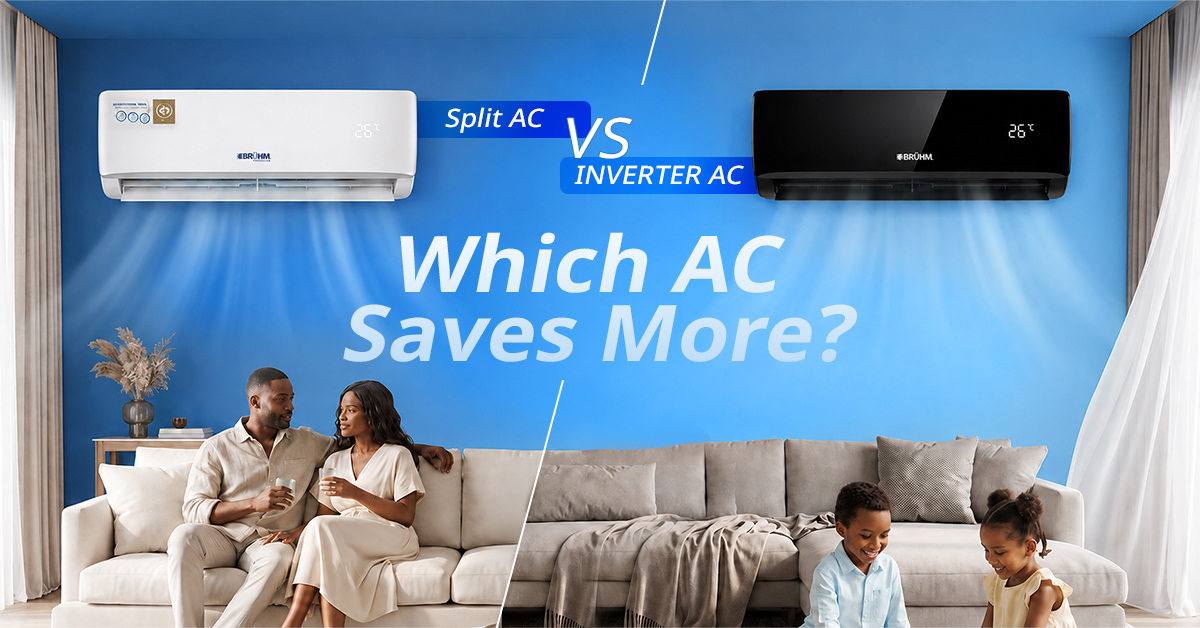
Are you tired of guessing if your air conditioner is actually saving you money or just spinning your electricity meter faster every time it’s switched on? That uncertainty makes choosing the right unit a gamble. Often, while shopping, you’re stuck in the split AC vs. inverter AC debate.
When you are browsing, a standard split AC might catch your eye. It looks like a bargain, and most modern units look sleek and stylish. But before you pay, it helps to look at the full picture and how that choice impacts your electricity bills and generator fuel in the long run.
Is an Inverter Split AC Worth the Investment?
An inverter split air conditioner might have a high initial cost, but the math usually favours the inverter. This is especially true if you run the unit for more than a few hours a day. Unlike its counterpart, a simple split AC, this unit avoids a stop-start cycle. Doing so keeps inverter AC power consumption low and steady. And, when you look at this low and steady power usage in the long run, those monthly savings from lower power consumption cover the extra cost of the energy-efficient AC model.
If you’re ready to start saving on your monthly electricity bills, you can browse our full range of Inverter Split AC models.
What about a Non-Inverter Split AC?
If you are worried about your electricity bill or the amount of fuel you pour into your generator, a standard unit might feel like a thorn in your side. Because it constantly cycles to maximum power, your costs will be much higher if the unit stays on for more than 3 to 4 hours a day.However, if you only need the AC to cool a guest room once in a while and aren’t bothered by the running costs, a standard AC could still do the job.
If you do go the standard route, use these pointers to keep things running efficiently:
- Lock the tempbetween 24°C and 26°C. Every degree below 24°C forces the motor to work way harder, and it won’t actually cool the room any faster.
- Use “Dry Mode” on humid days. In West Africa, that damp, heavy air can make the room feel much hotter than it is. The water drop icon on your remote pulls out moisture without blasting freezing air, saving you power.
- Leverage the timer at night. Program the unit to shut off an hour or two before you wake up. The room will stay cool enough, and you’ll save a nice chunk of electricity every single night.
If a standard unit better fits your budget and occasional usage needs, take a look at our collection of reliable Split ACs
Why Inverters Win the Split VS Inverter AC Debate
When it comes to the difference between split and inverter AC. Think of the two like this:
- A standard split AC acts like a car that only has two speeds: full throttle or dead stop. Once the room hits the right temperature, the compressor shuts off. When the room gets warm, it kicks back on at full blast. This constant “on-off” dance causes your electricity bills to soar because of the power needed to restart the motor every time.
- An inverter split air conditionerworks differently. Think of it like a car using cruise control. Instead of switching off, the compressor just slows down or speeds up to keep the temperature exactly where you want it.
Why Choose an Inverter AC: What Are Its Benefits?
- Quieter nights: No more jarring “click-and-whir” sounds that wake you up. The unit hums along quietly.
- Steady comfort: You get a constant flow of cool air instead of those frustrating swings between “freezing” and “stuffy.”
- Lasting life: Because the motor isn’t constantly slamming on and off, there is less mechanical stress, meaning the unit may last longer.
A Note on Grid Instability and Generators
In West Africa, we know the power grid can be jumpy. Because an inverter split air conditioneravoids those big power-hungry restarts, it puts a much gentler, steadier load on your generator. This means you’ll burn through less fuel during those long hours of backup power.
One important tip: because inverter models use sensitive electronics to manage that clever motor speed, they don’t like sudden voltage jumps. Always pair your unit with a good voltage stabilizer. It is a small extra cost that protects your long-term investment.
Conclusion
FAQs –
Yes. Unlike a normal unit that constantly turns off and on, an inverter split air conditioner modulates its compressor speed. This difference between split and inverter AC technology ensures it uses significantly less electricity to maintain your target temperature.
Most users see energy efficient ac savings between 30–50%. These inverter AC benefits depend on your room size, local climate, and how many hours you run the unit daily.
Yes. Choosing the correct capacity for your room is vital. An appropriately sized unit optimizes inverter AC power consumption because the compressor doesn’t have to strain to reach the desired temperature.
Not at all. If you only use your unit occasionally or need a lower upfront cost, a standard split AC vs inverter AC comparison shows that a non-inverter model can still be a practical solution.
For heavy users in hot, humid climates, you can often recover the higher purchase price in two to four years through lower electricity bills. This makes it an ideal energy saving air conditioner for daily use.
Yes. Because it avoids repeated, high-current startup spikes, it is easier on generators. However, because its electronics are sensitive, you should always use a voltage stabilizer to protect your energy efficient ac from power surges.
An inverter split air conditioner is generally more fuel-efficient when running on a generator due to its steady power draw. Just ensure you use a quality stabilizer to protect the sensitive internal components from unstable voltage.